Chemicals & Energy

Chemicals and Energy Reports

  • |

    Failure – Fear of Reprisals Keeps Industry Silent on Tariffs – This May Be the Worst Strategy, Leading to Business Failures

    • US industry is keeping quiet about the risksto White House policy. Assuming the plansmove forward (likely without objections) you mustcarefully assess plans for survival
    • No multinational company or anyone US only based, but reliant on imported inputs or exports for additional sales, will come out of this unscathed, and recession hurts all.
    • Harsh chemical industry downcycles are ALWAYS driven bydemand shock, never supply.Companies should not model past cycles butrather identify scenarios that could be fatal.
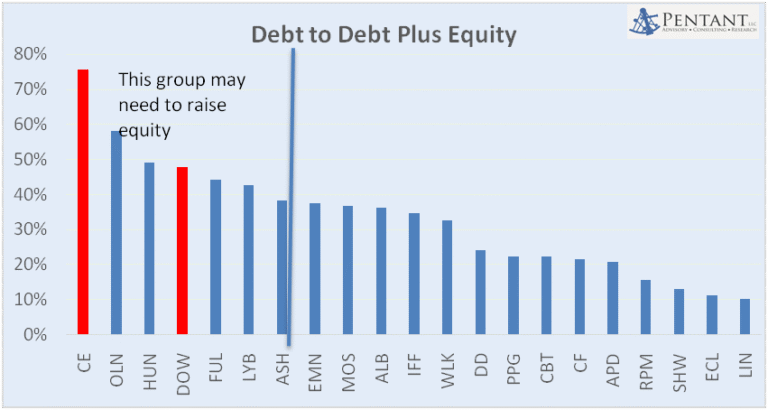
    • Except for the industrial gas companies, we have failure scenarios for every company in the chart below. Understanding what could drive failurewill improve balance sheet focus.
    • Q1 earnings calls will show who is taking the US policy risk seriously, but there are credible scenarios whereby everyone on the left side of the chart below should raise equity, soon.

  • Trading Jobs and Demand: The Inevitable Recession? – No Obvious Silver Linings

    With billions of dollars erased from chemical company valuations last week, and tariffs in full swing, some “left field” corporate strategy options may start to look less crazy
    Even if the Administration had a “just kidding” moment and tried to walk back recent trade orders and immigration hard lines, the damage is done, global consumers are holding back.
    Layoff risk is rising everywhere as companies take more cautious views – this is not just happening in transition – orders are shrinking and in our view a recession is now likely.
    Contagion in the US should spread elsewhere, and global economic growth in 2025 could disappoint meaningfully. Chemical industry surpluses will look much worse than expected.
    Lower than expected earnings in 2025 will drive faster failures in the transition space, and maybe some in chemicals where leverage is high. Rationalization for chemicals will follow.

  • A Plan For Europe: Cluster Opportunities Emerge From The Overall Mess

    As Europe wakes up to its need for greater self-reliance in defense it is inevitable that the attitudes towards industries that enable defense, like chemicals, will change. Is it too late?
    The overly pro-green backdrop in Europe has, by default, been overly anti-energy and old energy intense industries, incl. materials. Europe’s dependence on imports rises daily.
    While the relative cost pressures in Europe are unlikely to change quickly, there may be opportunities for cross-company agreements to protect clusters of businesses and assets
    Europe will need tariff protection to support its chemical industry and probably subsidies, but subsidizing a full value chain that has critical importance may be easier to support
    Europe needs to relax its competition regulations, as business combinations to drive every ounce of efficiency will be needed. There is likely more hope today than 6 months ago

  • Which Way Are You Facing? History May Have No Bearing, So “Eyes Front”

    • The smarter clients that we deal with at Pentant are those who look to the horizon rather than those who base their views on what they have experienced in the past.
    • Today, those looking to the horizon see a future that they struggle to understand, except to know that it does not look good, some facing backwards do so because it is less stressful.
    • What to do next requirespulling back to: “what do you believe”? Whether on demand, tariffs, transition, the competitiveness of China, circularity, oil and gas prices and demand.
    • It is very hard to identify any scenario that is good for the European industry, but almost equal challenges exist in South Korea, Japan, Taiwan, and many others, but not China.
    • At Pentant we focus on themes that we believe will drive profitability and behavior in chemicals and related industries. As themes play out, we will introduce new ones.